Contributor
No items found.




Healthcare communications teams in Indonesia sure don't have it easy!
You're working across 17,000+ islands, 279 million people, hundreds of languages, and wildly different levels of digital access. A campaign that lands in Jakarta might completely miss communities in Papua or Maluku.
For pharma companies, hospital groups, health tech firms, and public health organisations, understanding communication barriers in healthcare is where any decent strategy has to start. So what's actually getting in the way?
Indonesia's archipelago creates problems most markets don't have. The UN has verified over 16,000 islands. There are at least 1,300 ethnic groups. Getting health messages to travel consistently across that footprint takes more than a media buy.
Look at the healthcare workforce distribution: research in PLOS Global Public Health shows only 20% of physicians work in rural areas, despite 70% of the population living there. The physician-to-population ratio is 6 per 100,000 in rural regions. In urban centres, it's 36 per 100,000. Over in Nusa Tenggara-Maluku-Papua, more than half of community health centres don't have nearly enough doctors.
What does this mean for communications? Jakarta-centric media strategies won't cut it. You need different channels, localised messaging, and often reliance on community health workers to carry information the final mile.
Bahasa Indonesia is the official language, but over 700 regional languages exist across the country. That's a communication barrier in healthcare that catches many organisations off guard.
BPOM—Indonesia's food and drug authority– requires medicine advertisements to use Indonesian or local languages (bahasa daerah). They recognise that health literacy depends on people understanding what they're reading or hearing.
Translation alone won't solve this. Healthcare communications in Indonesia need transcreation: adapting messages so they make sense culturally and linguistically for specific communities. Word-for-word conversion doesn't cut it when you're trying to change health behaviours.
We saw this firsthand during Johnson & Johnson’s TB Warriors 2.0 PR campaign (August–September 2023), supported by the Ministry of Health of the Republic of Indonesia. Mutant led media dissemination and engagement efforts, tailoring campaign narratives for top-tier outlets and facilitating exclusive interviews with Johnson & Johnson’s Regional Public Health Strategy and Impact Lead for Southeast Asia & India. Through targeted outreach—including online press group interviews—we engaged 17 journalists from leading publications such as Popmama.com, Bisnis.com, and Parapuan.com. The campaign generated 36 pieces of coverage, reached more than 336.9 million people, delivered over IDR 2.2 billion in PR value, and saw more than 56% of articles published by top-tier media.
Indonesia has moved fast on digital health. Internet penetration hit 79.5% by 2024, and over 96% of users access the web via smartphones.
But those numbers contain a gap. Data from the Indonesian Central Bureau of Statistics puts Jakarta's internet access at 85%. Papua sits at 26%. Western provinces consistently outperform eastern ones on both connectivity and digital literacy.
Digital-first strategies will miss large chunks of the population. You need a mix: digital channels for urban audiences, traditional media, community health workers for rural areas, and local radio where connectivity drops off.
Healthcare advertising in Indonesia runs through BPOM. Regulation No. 2 of 2021 sets the framework: all content must be "objective, complete, and not misleading."
Some specifics worth knowing: prescription drugs can only be advertised in medical or scientific publications aimed at healthcare professionals. You can't use superlatives (no "number one," "the most," or "top"), and marketing authorisation is required before any advertising starts.
Corporate PR for healthcare brands in Indonesia needs compliance built in from the start. Retrofitting it later creates delays, rewrites, and sometimes reputational headaches.
Health misinformation is one of the more stubborn communication barriers in healthcare across Indonesia.
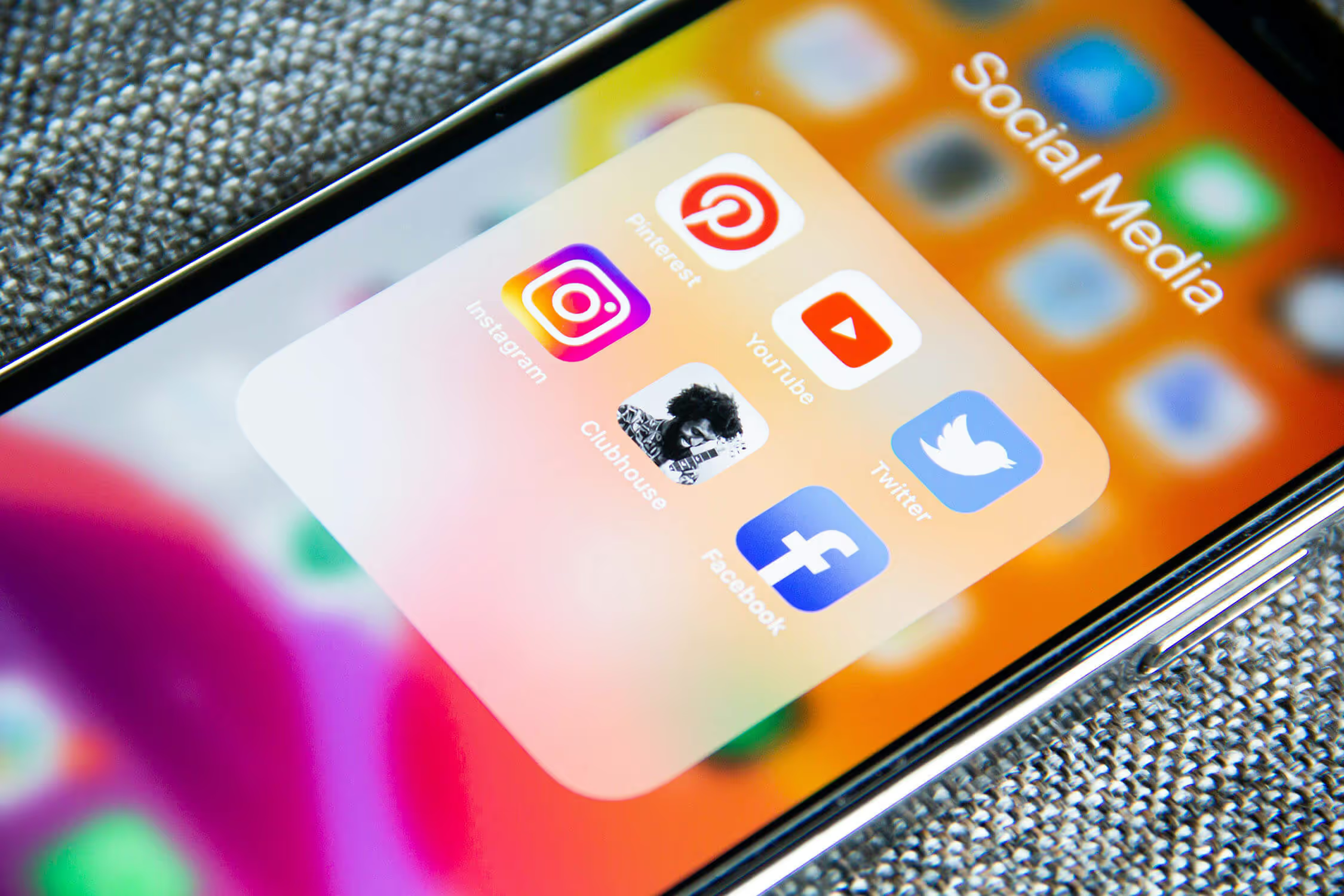
Research from Indonesian academics found that disinformation spreads six times faster than accurate information on digital platforms. During COVID-19, the government identified 359 health-related hoaxes in just three months—January to March 2020—mostly concerning health issues.
Publishing accurate information isn't enough anymore. You need proactive fact-checking partnerships, visual content (which research shows gets more attention than text-based corrections), and credible local voices delivering messages.
This is where strategic PR makes the difference. At Mutant Indonesia, we led a public education campaign for Kalventis focused on flu vaccination for the elderly and diabetes awareness. We managed and executed an on-site press conference attended by 42 top-tier media representatives, securing coverage across leading outlets such as Harian Kompas, Detik, and GridHealth.
The campaign generated over 100 media placements, achieved more than 2.3 billion in media reach, delivered over IDR 6.8 billion in PR value, and saw more than 70% of coverage come from top-tier media titles.
The urban-rural divide shapes how people receive and act on health information. Research in BMC Health Services Research found urban dwellers are 1.49 times more likely to use outpatient hospital services than those in rural areas. Transportation costs remain a primarybarrier for rural communities to access healthcare services.
Messaging that assumes easy access to healthcare facilities can frustrate rural audiences rather than help them. Healthcare communications campaigns need to acknowledge these realities and give people guidance that actually applies to their situation.
An urban-focused diabetes campaign might encourage people to “visit your nearest clinic for a quick HbA1c test” or “drop by a hospital after work for a screening.” For city residents with multiple clinics nearby and reliable public transport, this feels practical and achievable.
The same message, however, can fall flat in rural communities where the nearest hospital may be hours away and transport costs are a real burden. Instead, messaging that resonates with rural audiences would highlight alternatives—such as mobile health clinics, scheduled community screening days, or guidance on monitoring symptoms at home before a planned clinic visit.
Indonesia's cultural and kinship systems shape health decisions. Family members often have a say—sometimes even the final say—in certain healthcare choices. Communications targeting only individual patients may miss the people who actually influence the decision.
Religious considerations matter too. As the world's largest Muslim-majority nation, halal certification for pharmaceutical products affects acceptance. Understanding these dynamics helps you build messaging that speaks to how decisions actually get made, rather than how you wish they were made.
Addressing communication barriers in health care takes an integrated approach:
Segment by geography and access. National campaigns rarely work. Build region-specific strategies that reflect local infrastructure, language, and media habits.
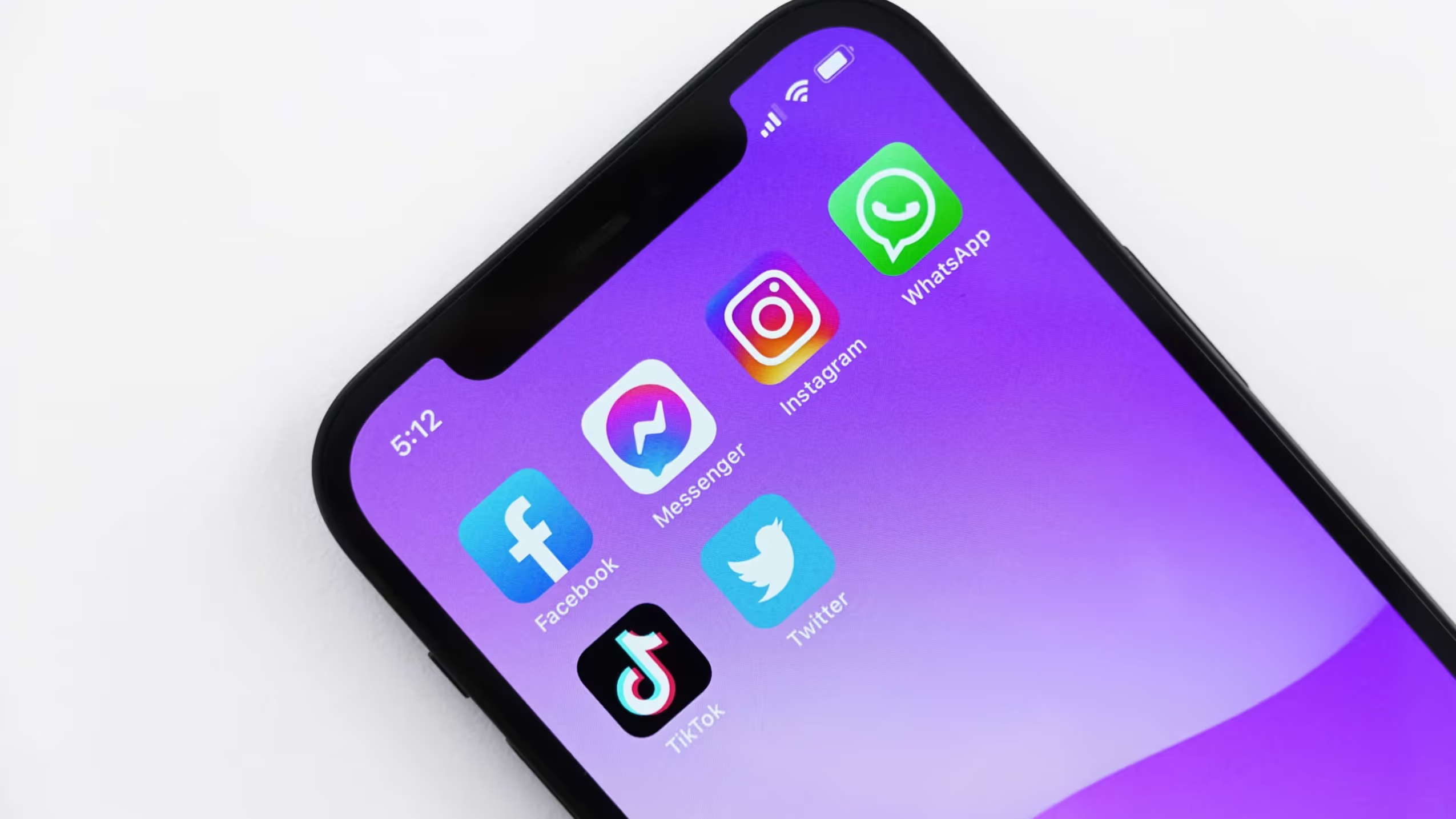
Mix your channels. Digital platforms (especially WhatsApp) work for urban audiences. Traditional media, community health workers, and local radio reach areas where connectivity drops.
Build compliance early. BPOM requirements shouldn't be an afterthought. Work with partners who understand the approval process and can navigate it without surprises.
Use local voices. Health experts and community leaders carry more trust than distant brands. Invest in spokesperson development and community engagement.
Lead with visuals. Given varying literacy levels and the proven effectiveness of visual content against misinformation, prioritise infographics, video, and images over text-heavy communications.
Successful healthcare communications in Indonesia come from working with the market's realities, not around them. Geography, language, regulation, and the digital divide aren't problems to sidestep—they're the context your communications have to fit.
Mutant's team builds messaging strategies around local market realities. We help healthcare and pharmaceutical clients navigate regulatory requirements while developing campaigns that reach the audiences who matter.
Want to talk through what Corporate PR in Indonesia looks like for your brand, whether in healthcare or beyond? Get in touch or send us an email at hello@mutant.co.id.
%20(1).avif)








.jpg)














.jpg)
.jpg)
%20(1).jpg)
.jpg)

.jpg)

.avif)
































.avif)







.avif)





.avif)




.avif)