Contributor
No items found.



.jpg)
Global brands often arrive in the Philippines with confidence. A polished APAC playbook. A hero video produced in Europe. A “locally translated” strapline that technically reads correctly, but never actually lands.
Then something predictable happens. The campaign goes live, and within days, it is being dissected, remixed, and rejected in public view. Not quietly. Not gradually. But fast, and often loudly.
This is not a one-off failure. It is a repeatable pattern in one of Southeast Asia’s most digitally engaged and culturally expressive markets. In fact, 88% of Southeast Asian consumers prefer advertising that reflects their actual lives, not simply language-localised versions of Western ideas.
The issue is simple: most global PR strategies are not designed for cultural truth. They are designed for regional consistency. And in the Philippines, that gap becomes visible quite obviously, immediately.
The Philippines is not just highly connected. It is culturally reactive at scale.
Filipino audiences do not passively consume campaigns. They interpret, discuss, and validate them through social networks in real time.
Key dynamics shaping this environment:
This means PR does not travel linearly from brand to audience. It travels laterally through communities.
A message is not “received.” It is debated.
Filipino audiences evaluate brand communication through deeply embedded cultural logic, often described through Sikolohiyang Pilipino.
Three concepts matter most in PR interpretation:
Pakikisama (collective harmony)
Messages that centre on overly individualistic empowerment often feel misaligned. Community fit matters more than personal aspiration.
Hiya (social propriety)
Tone is critical. Humour or messaging that feels demeaning, performative, or culturally unaware is quickly rejected.
Utang na loob (reciprocity)
Brands are remembered for presence, not campaigns. Showing up during crises or community needs carries more weight than episodic advertising bursts.
Together, these create a simple rule: If it feels externally imposed, it will not survive contact with local audiences.
Most failures are not creative accidents. They are structural decisions.
Global PR campaigns typically follow this pattern:
This leads to predictable outcomes:
The result is compliance, not resonance.
And in the Philippines, compliance is not enough.

The Department of Tourism’s campaign was pulled after audiences identified that its hero video used non-Philippine stock footage.
The issue was not technical. It was emotional. In a country where national identity and hospitality are deeply tied to pride, the visual misrepresentation felt like erasure.
The campaign collapsed quickly. Contracts were terminated. Trust damage was immediate.
The real failure: speed over cultural verification.
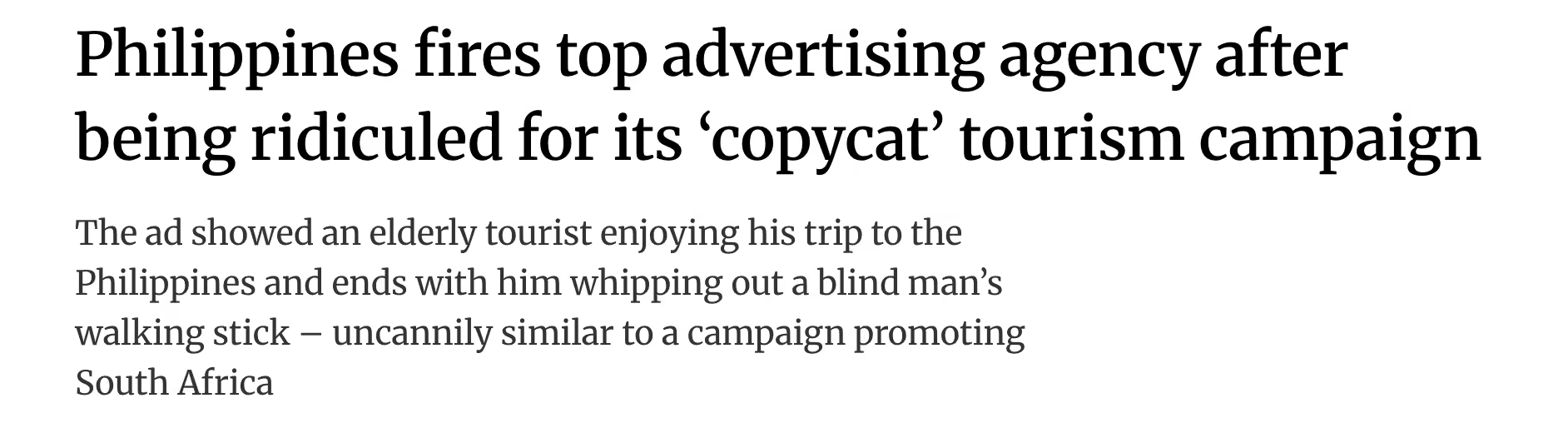
A previous tourism campaign was criticised for closely mirroring South Africa’s “Meet South Africa” concept.
Again, contracts were terminated. But the reputational impact lingered longer than the campaign itself.
The perception was clear: the Philippines was treated as a template market, not a culturally distinct one.
And in this market, that perception is often worse than the original mistake. What both cases reveal is not just creative oversight, but the speed of collective scrutiny in Filipino digital culture. Detection, amplification, and judgment happen almost simultaneously.
These failures are rarely about creativity. They are about system design.
Common blind spots include:
This creates a structural imbalance: global coherence is prioritised over local credibility.
And in the Philippines, credibility is the currency.
Fixing this is not about adding localisation. It is about redesigning the input stage. Key shifts include:
Global PR fails in the Philippines for a simple reason: it confuses consistency with relevance.
But the same conditions that expose weak campaigns also reward strong ones. When brands invest in cultural intelligence, build with local voices, and anchor messaging in lived reality, the response is not just engagement. It is loyalty.
And loyalty in this market is not manufactured through media spend. It is earned through cultural accuracy, consistency, and respect.
The shift is clear: from exporting campaigns to co-creating meaning.
Mutant helps brands design PR, content, and storytelling systems that don’t just travel across markets, but actually land in them. Drop us a note: hello@mutant.co.ph
%20(1).avif)









.jpg)















.jpg)
%20(1).jpg)
.jpg)

.jpg)

.avif)


































.avif)







.avif)





.avif)




.avif)